The Great Goddess — Fertility, Grain, and the Deep Feminine
c. 25,000 BCE – 400 CE | a thematic thread across all periods
♀
A cross-period thematic section. The mother goddess / fertility complex is not confined to one era: it runs beneath the entire timeline, from Palaeolithic figurines to the Eleusinian Mysteries and beyond. This section traces that thread explicitly, linking back to the agricultural foodways of the first timeline and forward to a later discussion of gender, family, and religious authority. The key question is whether this represents a single coherent tradition of goddess worship that was progressively displaced by the sky-god pantheons traced above, or a series of independently recurring responses to the same fundamental experiences of birth, death, and harvest.
c. 25,000 – 4,000 BCE · Europe and Near East broadly
Venus figurines — the oldest religious images in the world origin
Hundreds of small female figurines — exaggerating breasts, hips, and abdomen — have been found across Europe and the Near East from the Gravettian period onward. The Venus of Willendorf (c. 25,000 BCE, Austria), the Venus of Laussel (c. 23,000 BCE, France), and dozens of Anatolian examples cluster around sites of communal activity. Their purpose is debated: fertility charm, ancestral deity, or self-representation. What is certain is that the female body as a locus of sacred power is the oldest continuous religious theme in human art — predating agriculture, writing, and all the pantheons on this timeline.
Naturhistorisches Museum Vienna — Venus of Willendorf (collection and research record)
Naturhistorisches Museum Vienna — Venus of Willendorf (collection and research record)
c. 5,000 BCE · Sumer
Ninhursag — “Lady of the Sacred Mountain,” mother of the gods
Ninhursag (also Ki, Ninmah, Nintu) is one of the four Sumerian creator deities alongside An, Enlil, and Enki. She fashions humanity from clay in several creation narratives and is the divine mother of kings. Her association with cattle, milk, and the steppe links her directly to the pastoral economy of early Mesopotamia. The myth of Enki and Ninhursag describes a garden paradise (Dilmun) where she heals the wounds Enki inflicts on himself by eating her sacred plants — a text with structural echoes in the Eden narrative. In the Linear B tablets, no equivalent figure survives by name, but the Minoan evidence suggests a comparable sacred feminine presence in the Aegean Bronze Age.
Oxford ETCSL — Enki and Ninhursag
Oxford ETCSL — Enki and Ninhursag
c. 3,000 BCE · Sumer
Nisaba — goddess of grain, writing, and accounting
Nisaba is the Sumerian goddess of grain, reeds, and — crucially — writing and accounting. Scribes invoked her at the opening of texts; the reed stylus was her instrument. Her dual role as grain goddess and goddess of literacy makes her a remarkable figure for a course that will later discuss the emergence of writing: she embodies the argument that writing and agriculture are not merely parallel developments but intimately connected, since the first texts are grain-ration records. She is a direct link between the foodways timeline and the mythology of intellectual life. Her Roman equivalent Ceres (grain) and her partial Greek equivalent Demeter both strip out the literary dimension, leaving only agriculture.
Oxford ETCSL — Hymn to Nisaba
Oxford ETCSL — Hymn to Nisaba
c. 2,000 – 500 BCE · Anatolia (Phrygia) and later Rome
Cybele — the Great Mother from Anatolia to Rome
Cybele (the Phrygian “Great Mother”, Matar Kubileya) is the most direct descendant of the Anatolian goddess tradition in the western Mediterranean. Her cult centred on a sacred black stone (possibly a meteorite) at Pessinus; her consort Attis dies and is resurrected annually, mirroring the Dumuzi/Inanna and Adonis cycles. The Roman Senate formally adopted her cult in 204 BCE, importing her black stone to Rome as a war measure against Hannibal — a remarkable moment where a Neolithic Anatolian goddess tradition was conscripted into Roman imperial religion. She prefigures the Virgin Mary in significant iconographic respects.
Roller, “The Great Mother at Gordion: The Hellenization of an Anatolian Cult,” JHS 111 (1991) — search title in JSTOR
Roller, “The Great Mother at Gordion: The Hellenization of an Anatolian Cult,” JHS 111 (1991) — search title in JSTOR
25,000 BCE
5,000 BCE
3,000 BCE
2,000 BCE
c. 6,000 – 1,400 BCE · Crete and the Aegean
The Minoan goddess complex — a feminine-centred religion? key question
Minoan Crete presents the most concentrated Bronze Age evidence for a goddess-centred religion in the Aegean. The Snake Goddess (c. 1,600 BCE, already illustrated above), the Mountain Mother on seal rings, the Poppy Goddess (associated with opium, ecstasy, and the underworld), and the female figures presiding over peak sanctuaries all suggest a religious world in which the dominant sacred figure is female. Marija Gimbutas’s influential but contested hypothesis argues that pre-Indo-European Europe was broadly matrilineal and goddess-worshipping, and that the arrival of Indo-European-speaking peoples (including proto-Greeks) imposed a sky-god patriarchal religion upon it. Whether or not one accepts Gimbutas, the contrast between the Minoan visual record and the male-dominated Linear B pantheon (Zeus, Poseidon, Ares…) requires explanation.
Goodison & Morris, “Beyond the Great Mother” (critical reassessment) — search title in JSTOR
Goodison & Morris, “Beyond the Great Mother” (critical reassessment) — search title in JSTOR
c. 700 BCE · Hesiod, Theogony
Gaia, Rhea, Hera — the suppressed feminine in the Greek succession myth
Hesiod’s Theogony begins with Gaia (Earth) as the primordial generating force — she gives birth parthenogenetically, creates Ouranos (sky) as her own mate, and initiates the succession crisis by arming Kronos against his father. She is more powerful than any male deity in the poem’s cosmogony, yet by its end she is subordinated to Zeus. Rhea, the Titaness who saves Zeus, is structurally equivalent to Ninhursag (who saves the god of wisdom in Sumerian myth) and to Cybele (the Phrygian Great Mother). Hera, Zeus’s queen, retains the political power of the old goddess tradition but is systematically humiliated in Homer. The “patriarchal takeover” is not a modern feminist reading: it is inscribed in the structure of Hesiod’s own text.
c. 650 BCE · Eleusis
Demeter and the Eleusinian Mysteries — the goddess who outlasts the Olympians
Demeter (whose name may mean “grain mother” — dē + mētēr) is the Olympian goddess closest to the old fertility goddess tradition. Her Eleusinian Mysteries — celebrated continuously for nearly 1,000 years — were the most important religious institution in classical Greece. Their content was secret, but their structure (descent, loss, return, renewal) mirrors the Inanna descent narrative. Initiates were promised a blessed afterlife: a promise not offered by standard Olympian religion. Demeter is also the direct link between this timeline and the foodways timeline: she is the grain itself, the agricultural cycle personified, the deity whose “holy fruits” Hesiod instructs his brother to harvest in due season. She survives the patriarchal Olympian settlement precisely because you cannot separate the goddess of grain from the grain.
Richardson, “The Eleusinian Mysteries” (peer-reviewed) — search title in JSTOR
Richardson, “The Eleusinian Mysteries” (peer-reviewed) — search title in JSTOR
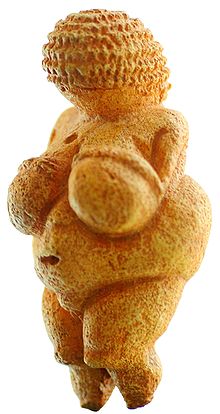
Venus of Willendorf, c. 25,000 BCE. Naturhistorisches Museum, Vienna. The oldest religious image in the world with a possible goddess interpretation. Her anonymity — no face, no identity, only body — marks the difference between a personalised deity and a sacred force.
Wikimedia Commons (public domain)
Wikimedia Commons (public domain)
Cognate chain — the feminine divine
Earth / mother: Ninhursag / Ki (Sumer) → Rhea (Greece) → Cybele (Phrygia/Rome) → Gaia (Hesiod) |
Grain goddess: Nisaba (Sumer) → Isis (Egypt, grain aspect) → Demeter (Greece) |
Love / fertility: Inanna → Ishtar → Astarte → Aphrodite |
Underworld keeper: Ereshkigal (Sumer) → Persephone / Hecate (Greece) |
War goddess: Anat (Ugarit) → Athena (Greece) |
The triad: in both Canaanite and Greek traditions a group of three goddesses divides the feminine divine: love, war, and sovereignty. The Greek Hera/Athena/Aphrodite triad that judges Paris is the Asherah/Anat/Astarte triad of the Baal Cycle, one generation on.
↔
Links: Foodways timeline ↔ Mythology timeline ↔ Gender & Family (later discussion)
The grain goddess (Demeter/Nisaba/Inanna) is the theological expression of the agricultural system traced in the foodways timeline. She connects the two sets of material directly. Looking forward: the progressive marginalisation of goddess figures within the Greek Olympian pantheon — from Gaia’s sovereignty in the Theogony to Hera’s subjugation in Homer — is the mythological trace of real changes in gender relations, inheritance patterns, and religious authority that the later gender and family discussion will examine from the social and legal side.
Women as Mourners — Prothesis, Lamentation, and the Art Historical Record
c. 900 – 400 BCE
☠
The most fully documented female ritual role in archaic Greece. Before the oikos, before the law court, before the symposium, women appear in the visual record doing one thing consistently and prominently: mourning the dead. The transition from geometric stick-figure mourners (c. 760 BCE) to the controlled, nearly invisible women of classical funerary art tracks a real social history — the progressive legal restriction of female lamentation. Alan Shapiro’s art-historical timeline is the methodological model for this entire section: reading the visual record as social history.
c. 1,800 BCE · Mesopotamia
Professional female mourners in the ancient Near East
Sumerian lament literature is performed by female voices; the “Lament for the Destruction of Ur” is voiced by the goddess Ningal mourning her city. Professional female mourning guilds are attested in Mesopotamian texts. The association of women with lamentation is not a Greek invention: it is a deep Near Eastern tradition in which women mediate between the living and the dead, their voices authorised to speak what male public discourse suppresses.
Oxford ETCSL — Lament for the Destruction of Ur
Oxford ETCSL — Lament for the Destruction of Ur
c. 594 BCE · Athens
Solon restricts female lamentation — the state enters the oikos
Solon’s laws (c. 594 BCE) restrict female participation in funeral ritual: women under sixty who are not close relatives are banned from prothesis and ekphora; self-laceration, breast-beating, and improvised lament are curtailed. The laws are civic management of a female-controlled space. Their effect — fully visible in the visual record — is to diminish women in the funerary image from prominent, gesturing mourners to quiet, peripheral figures. The state does not abolish female lamentation; it disciplines it.
IWU Digital Commons — Stears, “Dead Women’s Society,” in Time, Tradition and Society in Greek Archaeology (open access)
IWU Digital Commons — Stears, “Dead Women’s Society,” in Time, Tradition and Society in Greek Archaeology (open access)
900–700 BCE
594 BCE
c. 760–700 BCE · Athens — Late Geometric period
The Dipylon Master and the prothesis amphora — women central, gesturing, visible key image
The monumental Dipylon-style amphorae and kraters produced for the graves of elite Athenians show the prothesis scene — the laying-out of the body — in registers of schematic figures. Women, identifiable by their triangular torsos and by the gesture of both hands raised to the head (tearing hair), are the dominant and most numerous figures. They are not peripheral: they are the ritual action. Alan Shapiro’s analysis of this corpus establishes the art-historical baseline: at this period, female lamentation is publicly authorised, visually prominent, and central to the funerary economy.
Shapiro, “The Iconography of Mourning in Athenian Art” AJA 95 (1991) — search title in JSTOR
Shapiro, “The Iconography of Mourning in Athenian Art” AJA 95 (1991) — search title in JSTOR
c. 530–400 BCE · Athens — Black and red-figure lekythoi
White-ground lekythoi: women at the grave — present but quieted
The white-ground lekythos tradition (c. 470–400 BCE) depicts women visiting graves: bringing offerings, binding fillets, sitting in contemplation. The gestures of wild lamentation have been removed; the women are graceful, composed, melancholy. This is Solon’s legislation made visible. The pathos of the images derives precisely from what has been suppressed: the controlled figures carry the traces of the uncontrolled grief they are no longer permitted to perform publicly. Nicole Loraux calls this “the privatisation of mourning.”
Oakley, “The Depiction of Grief in Attic Vase Painting” — search title in JSTOR
Oakley, “The Depiction of Grief in Attic Vase Painting” — search title in JSTOR
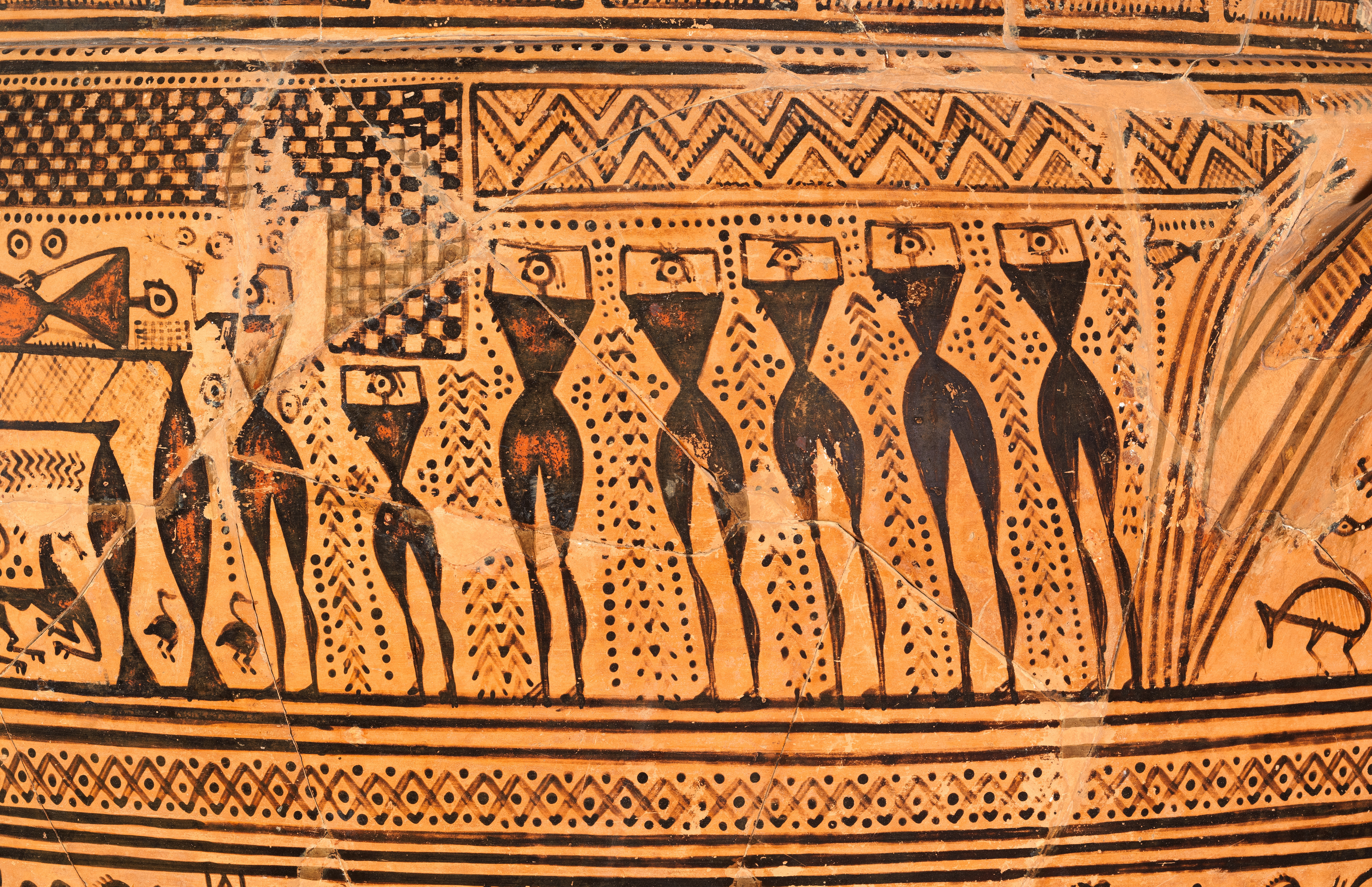
Detail: mourning women register, Attic Geometric krater, c. 750–735 BCE. Metropolitan Museum of Art, New York (acc. 14.130.14). This close detail shows the mourning register in full: a dense frieze of figures whose triangular silhouettes — the pointed torso of the Geometric female convention — are interrupted by raised arms and dotted-chevron patterning representing hair or garments in the act of tearing. The figures face left in procession; the repetition and compression convey collective, formalised grief rather than individual anguish. These are the women Solon’s legislation of 594 BCE will progressively push to the margins of the funerary image. Compare with the lekythos below: same occasion, same women, two centuries and one set of sumptuary laws later.
Metropolitan Museum of Art — collection record
Metropolitan Museum of Art — collection record

White-ground lekythos, Achilles Painter, c. 440 BCE. A woman stands before a grave stele, holding a fillet. The gestures of wild lamentation visible in the Geometric detail above have been entirely suppressed; what remains is composed, inward, melancholy. The contrast between the two images enacts the argument of the entire era.
Wikimedia Commons
Wikimedia Commons
The Oikos — Wife, Mother, and the Architecture of Seclusion
c. 600 – 300 BCE
🏠
The Greek household as female space and female prison. The oikos — household, estate, family unit — is simultaneously the domain women control and the enclosure that confines them. The gynaikon (women’s quarters), the requirement of a male guardian (kyrios), perpetual legal minority, and the ideology of feminine virtue as invisibility combine to produce a social formation that is well-documented in both prescriptive literature (what women ought to do) and in the gaps of the visual and legal record (what women actually did). The contrast between prescription and practice is the central critical problem of this section.
c. 1,400 BCE · Mycenaean Greece / Near East
Bronze Age women in the palace economy — the Linear B record
Linear B tablets at Pylos record hundreds of women workers: grain-grinders, textile workers, bath attendants, assigned to palace industries with their children, receiving ration allocations. These are not wives: they are unfree or semi-free workers, many possibly displaced by war or famine. Their rations are lower than male workers’. The tablets thus establish from the beginning of Greek literacy a two-track female existence: the high-status wife of the palace official (invisible in the tablets, because she does not work for a ration) and the labouring woman dependent on institutional allocation.
DAMØS Oslo — Linear B tablet database — database home page; search within DAMØS for the relevant tablets (no direct link to individual records)
DAMØS Oslo — Linear B tablet database — database home page; search within DAMØS for the relevant tablets (no direct link to individual records)
c. 380 BCE · Athens
Xenophon’s Oeconomicus — the training of a wife
Xenophon’s dialogue on household management includes the extended monologue of Ischomachus describing how he trained his fourteen-year-old bride to run his household. The text is the most detailed prescriptive account of elite Athenian marriage we have: the wife must stay indoors, manage the slaves, oversee stores, and make herself up appropriately (but not excessively). She is compared to a queen bee. The text is invaluable as ideology — it shows us what an Athenian gentleman thought the ideal wife should be. It is not reliable evidence for what Athenian women actually did.
Project Gutenberg — Xenophon, Oeconomicus, full text
Project Gutenberg — Xenophon, Oeconomicus, full text
1,400 BCE
431 BCE
380 BCE
c. 600–400 BCE · Athens
The kyrios system — women as perpetual legal minors
In classical Athens a free woman required a kyrios (guardian) for all legal and financial transactions: father before marriage, husband after, son if widowed. She could not own property above a trivial threshold, initiate legal proceedings, or make contracts. She was transferred at marriage like property: the verb is ekdidosthai (to give out), and the marriage ceremony (ekdosis) involved the formal handing-over by the father. The citizen woman’s legal invisibility is structural, not accidental: it is the precondition of the Athenian male citizen’s political identity, which depends on knowing the legitimacy of his heirs.
Sealey, “On Lawful Concubinage in Athens” — search title in JSTOR
Sealey, “On Lawful Concubinage in Athens” — search title in JSTOR
431 BCE · Athens — Pericles’ Funeral Oration
“Your greatest glory is not to be worse than your nature” — Pericles on women
In Thucydides’ account of Pericles’ Funeral Oration (Book II, 45), the great democratic statesman addresses the widows of the war dead with the most famous dismissal of women in Greek literature: the best woman is she of whom there is least talk among men, whether for praise or blame. The sentence is striking for what it reveals about the ideology of feminine virtue: it consists entirely of invisibility. Pericles’ partner Aspasia — an educated Milesian woman who arguably shaped his rhetoric and thinking — sits outside this formulation entirely. The gap between Aspasia and the anonymous widows is the gap the whole timeline explores.
Theoi.com — Thucydides, History Book II (Funeral Oration)
Theoi.com — Thucydides, History Book II (Funeral Oration)
Women in the Economy — Traders, Retailers, and Brothel-Keepers
c. 600 – 300 BCE | a counter-current to the ideology of seclusion
∓
The gap between ideology and practice. The Athenian ideology of female seclusion (the gynaikon, the kyrios, Pericles’ formulation that the best woman is least spoken of) describes what elite men thought should happen. The legal and comic record reveals what actually did: women worked in markets, ran retail stalls, lent money informally, and owned commercial operations including brothels. The gap between the Ischomachus ideal and the Aristophanic market-woman is one of the most productive tensions in the source record for this course. The critical question is not “which picture is true?” but “which kinds of women does each picture describe, and why does the elite literary record largely suppress the second?” Note: the pornoboskos (brothel-keeper) is treated in detail in Era 4; this section establishes the economic infrastructure that made that institution possible.
c. 1,950–1,750 BCE · Old Assyrian merchant network
Women as commercial correspondents in the Old Assyrian trade colony network
The c. 23,000 cuneiform tablets from Kültepe-Kaneš in Anatolia (the archive of the Old Assyrian merchant colony) include substantial correspondence by women in Assur who managed the home-end of the textile trade while their husbands ran the Anatolian sales operation. Women purchased raw wool and linen, organised weaving workshops, packed and dispatched consignments, and maintained the commercial accounts. Cécile Michel’s detailed analysis of the women’s letters shows that wives and daughters were essential, not peripheral, to the commercial system. Their role was economically indispensable even as the formal legal and religious discourse framed women as dependants. This is the earliest documented case of a systematic gap between female economic practice and female legal standing.
Michel, “Women of Aššur and Kaneš,” in Textile Terminologies (2010) — search title in JSTOR
Michel, “Women of Aššur and Kaneš,” in Textile Terminologies (2010) — search title in JSTOR
c. 600–400 BCE · Neo-Babylonian period
Neo-Babylonian women managing property — the gap between legal disability and economic reality
Neo-Babylonian temple and private archives document women managing property, entering commercial contracts, lending at interest, and appearing in court as independent parties — formally in the name of a male guardian, but in practice autonomously. The Egibi family archive from Babylon (6th century BCE) includes women negotiating loans and directing slave labour. Martha Roth’s analysis of the Babylonian law codes and their relationship to actual legal practice shows that the formal requirement of a male guardian did not prevent women from conducting commercial life; it simply added a layer of formal representation. The parallel with Athens — where the kyrios system was also formally absolute but practically permeable — is direct and methodologically important.
Roth, “Marriage, Divorce, and the Prostitute in Ancient Mesopotamia” in Faraone & McClure (2006) — search title in JSTOR
Roth, “Marriage, Divorce, and the Prostitute in Ancient Mesopotamia” in Faraone & McClure (2006) — search title in JSTOR
1,900–1,700 BCE
600–400 BCE
c. 400 BCE
c. 500–380 BCE · Athens — the agora and retail trade
Women in the Athenian marketplace — the evidence of comedy and law key evidence
Roger Brock’s systematic survey of the evidence for women’s labour in classical Athens (CQ 1994) demonstrates that women worked visibly and consistently in the Athenian agora as retailers: selling garlands, bread, vegetables, ribbons, and cooked food. Aristophanes’ comedies document market-women as familiar comic types — the garland-seller in Plutus, the sausage-seller’s mother in Knights, the linen-seller haranguing Dikaiopolis in Acharnians — which suggests their presence was normal enough to be a reliable comic target. These are not hetairai or slaves: they are free working women, largely poor, operating outside the ideology of elite seclusion. Brock argues that the scholarly focus on upper-class female seclusion has systematically obscured the working lives of the majority of Athenian women.
Brock, “The Labour of Women in Classical Athens,” CQ 44.2 (1994) — search title in JSTOR
Brock, “The Labour of Women in Classical Athens,” CQ 44.2 (1994) — search title in JSTOR
c. 380 BCE · Athens
Schaps on economic rights — the formal law vs. commercial reality
David Schaps’s foundational study (Edinburgh, 1979) establishes the formal legal framework: Athenian women could not, in law, conduct transactions above the value of one medimnos of barley (enough to feed a family for a few days). In practice, as Schaps demonstrates through the speech evidence and the forensic record, women lent money informally, managed household finances, and participated in the grey economy of retail trade with considerable autonomy. The formal incapacity was real but targeted: it prevented women from making large transfers of property — the transactions that mattered for the transmission of citizenship and inheritance — while leaving everyday commercial activity largely unregulated. This is the economic parallel to the kyrios system’s political function: not abolishing female agency, but channelling it away from the transactions that determined civic identity.
Schaps, “The Woman Least Mentioned,” CQ 27.2 (1977) — search title in JSTOR
Schaps, “The Woman Least Mentioned,” CQ 27.2 (1977) — search title in JSTOR
c. 400–340 BCE · Athens and Corinth
The pornoboskos — women as brothel-owners and managers
The most striking economic role available to women outside the oikos is the one least often noted: the pornoboskos (brothel-keeper) was frequently a woman. The clearest documented case is Nikarete, who appears at the opening of Against Neaira (sections 18–49): a freedwoman who purchased seven young girls, trained them as hetairai, hired them out serially to wealthy men, and eventually sold them when they had earned her their price. Nikarete operated a profitable commercial enterprise, managed a workforce, negotiated contracts, and was wealthy enough to be dealing with citizens and foreign visitors at a high level. She appears in the speech as a fact requiring no special comment: a businesswoman in a recognised trade. Edward Cohen’s analysis of Athenian prostitution as a commercial economy — not a social deviance — shows that the pornoboskos functioned within normal Athenian commercial structures, using the same slave-purchase and hire mechanisms as any other skilled-labour enterprise. ↓ See Era 4: Hetairai, Pornai, and Sex Slavery for the full legal and social analysis
Cohen, E.E. Athenian Prostitution: The Business of Sex (Oxford University Press, 2015), ch. 2 — OUP catalogue record
Cohen, E.E. Athenian Prostitution: The Business of Sex (Oxford University Press, 2015), ch. 2 — OUP catalogue record
Cross-period pattern
From the Old Assyrian textile correspondents to the Neo-Babylonian property-managers to the Athenian market-women and pornoboskoi, the pattern is consistent: formal legal disability and everyday economic participation coexisted, without contradiction, across the ancient world. The legal system defined what women could not own or inherit; it did not prevent them from earning, managing, or deploying resources within those limits. The methodological point for this course: the absence of women from formal legal documents is not evidence of the absence of women from economic life. It is evidence of the specific boundaries within which their economic activity was confined — and those boundaries tell us what the legal system was actually protecting.
Sappho of Lesbos — The Woman Who Wrote Back
c. 630 – 570 BCE | archaic lyric and the female voice
♪
The exception that measures the rule. Sappho is the only woman from the ancient Greek world whose poetry survives in substantial quantity, and whose literary reputation in antiquity was treated as equal to the canonical male poets. Plato called her the tenth Muse. Strabo placed her alongside Homer. She was produced by the same archaic world that was simultaneously constructing the oikos ideology, the kyrios system, and the mourning restrictions documented in Eras 1 and 2 — but from Lesbos, not Athens, and within a form of female community for which we have no equivalent in the Athenian record. Studying Sappho in this course is not primarily an exercise in literary appreciation. It is a methodological exercise: what does the existence of Sappho, and the near-total loss of her work, tell us about the structure of survival, and about what it costs a culture to suppress the female lyric voice? The section below also confronts the transmission problem directly — why we have so little, how two major fragments were recovered from rubbish heaps in 2004 and 2014, and what that tells us about whose words were worth preserving.
c. 2,300 BCE · Sumer — the first named author
Enheduanna of Ur — a female predecessor three millennia earlier precedent
Enheduanna, daughter of Sargon of Akkad and high priestess of the moon god Nanna at Ur (c. 2285–2250 BCE), is the earliest named author in human literary history of either sex. Her surviving works include the Hymn to Inanna and the Exaltation of Inanna, which are the first texts in the world where a named author uses the first-person singular to describe her own emotional and spiritual experience. The parallels with Sappho are structural rather than direct: both are women in religious and educational roles at the margins of the primarily male political structure; both write in the first person about inner experience; both survive in the record against the statistical odds. The parallel is not a coincidence: women with access to education and religious authority are the consistent exceptions to the rule of female textual silence, in every period from Sumer to late antiquity.
Oxford ETCSL — Enheduanna, The Exaltation of Inanna, full text
Oxford ETCSL — Enheduanna, The Exaltation of Inanna, full text
c. 1,000–600 BCE · Near Eastern lyric traditions
Female lyric voices in the Near Eastern record — the tradition Sappho inherits
Female voices in Near Eastern lyric are not exclusively divine or priestly. The Song of Songs (Hebrew Bible, c. 950–450 BCE) contains sustained first-person female erotic lyric — “I am the rose of Sharon” — that is among the most powerful female voices in any ancient literature and whose formal structure (the beloved’s praise of her lover, the lover’s description of her own longing, the use of natural imagery for erotic experience) is precisely the tradition Sappho works within. Whether this represents a shared eastern Mediterranean lyric convention for female erotic speech, or parallel development, is debated; what is clear is that Sappho’s use of the first-person female erotic voice does not appear from nowhere. It draws on a lyric tradition in which women’s desire had been given formal expression for centuries. The difference is that Sappho’s desire, as she writes it, is for women.
Snyder, “Public Occasion and Private Passion in the Lyrics of Sappho of Lesbos,” in Pomeroy (ed.), Women’s History and Ancient History (1991) — UMD library access
Snyder, “Public Occasion and Private Passion in the Lyrics of Sappho of Lesbos,” in Pomeroy (ed.), Women’s History and Ancient History (1991) — UMD library access
c. 2,300 BCE
c. 630–570 BCE
c. 620 BCE
c. 600 BCE
3rd c. BCE →
c. 630–570 BCE · Mytilene, Lesbos
Sappho — biography, the thiasos, and the problem of sources key figure
Sappho was born into an aristocratic family on the island of Lesbos, probably in Eressos or Mytilene, c. 630 BCE. She was exiled to Sicily at some point (probably during political upheaval in Mytilene c. 600 BCE) and returned. She mentions a daughter, Cleis, by name in the fragments. She led or participated in a thiasos — a community of women gathered around the worship of Aphrodite and the Muses, in which young women were educated in music, poetry, and ritual. The nature of the thiasos is one of the most contested questions in classical scholarship: was it a school, a religious guild, a pre-marriage preparation group, a same-sex community organised around female desire, or some combination? The ancient sources do not agree, and the modern scholarly consensus has shifted significantly since the 19th century. What is not contested: the poems describe intense emotional and erotic attachments between women, in Sappho’s own name.
Parker, “Sappho Schoolmistress,” TAPA 123 (1993) — search title in JSTOR
Parker, “Sappho Schoolmistress,” TAPA 123 (1993) — search title in JSTOR
c. 620–600 BCE · Lesbos — Fragment 1
The Hymn to Aphrodite — the only complete poem primary text
Fragment 1, the Hymn to Aphrodite, is the only poem by Sappho that survives complete, preserved by Dionysius of Halicarnassus in a discussion of literary style. The speaker addresses Aphrodite directly, asking for help in love; Aphrodite answers in person, asking “who has wronged you now?” and promising that the beloved will soon turn to pursue the speaker. The poem is remarkable for several reasons simultaneously: it is formally perfect (seven stanzas of Sapphic metre), theologically orthodox (Aphrodite is a real presence, not a metaphor), and entirely organised around the speaker’s own desire for an unnamed woman. The gender of the beloved is not ambiguous in the Greek: the pronouns are unambiguously female. The poem has been transmitted across two and a half millennia as a canonical specimen of Greek lyric; the female desire at its centre has been variously explained away, celebrated, and suppressed depending on the period of transmission.
Poetry Foundation — Sappho: poems and fragments in translation
Poetry Foundation — Sappho: poems and fragments in translation
c. 610–580 BCE · Lesbos — Fragment 31
Fragment 31 — jealousy, the body, and the sublime primary text
Fragment 31 is preserved by Longinus in On the Sublime (1st century CE) as the supreme example of the literary representation of intense physical experience. The speaker describes watching a man sit close to a woman she desires: her tongue breaks, her eyes see nothing, her ears ring, sweat pours down her, she trembles, she is greener than grass, she seems almost dead. Longinus praises the poem for its unity of contradictory sensations. For this course, Fragment 31 is important on three levels: first, as the earliest surviving first-person description of physical desire in Western literature; second, as a formally perfect specimen of what the Greeks understood as lyric subjectivity; and third, as a reminder that the speaker’s desire is for a woman, observed next to a man who is praised for being her equal (“equal to the gods”) — and that the comparison is not in the man’s favour.
Carson, “Sappho Fragment 31: Anxiety, Desire, and the Lyric Body,” in Arion (2003) — search title in JSTOR
Carson, “Sappho Fragment 31: Anxiety, Desire, and the Lyric Body,” in Arion (2003) — search title in JSTOR
2004 & 2014 · Cologne and Oxford — disputed provenance
The Tithonus poem and the Brothers poem — recovery, scandal, and the limits of new evidence provenance dispute
In 2004 a new Sappho poem was identified on a papyrus in the Cologne collection (P.Köln inv. 21351+21376): the “Tithonus poem,” in which Sappho reflects on ageing with extraordinary lucidity, using the myth of Tithonus (granted immortality but not eternal youth) as a mirror for her own situation. This find is uncontested: the papyrus has a clear, documented institutional provenance. In 2014 a second poem — the “Brothers poem,” discussing Sappho’s brothers Charaxos and Larichos — was published by Dirk Obbink in Zeitschrift für Papyrologie und Epigraphik 189 (2014), based on a papyrus from an unnamed private collection. This find has since become the centre of a major provenance and authenticity scandal. Obbink, then a leading papyrologist at Oxford, was subsequently found to have sold papyri from the Green Collection (the Hobby Lobby antiquities collection) illegally; criminal proceedings and retractions followed. The Society for Classical Studies issued a formal notice raising concerns about the Brothers poem’s authenticity and provenance. Brent Nongbri and others have raised the possibility that the papyrus is either a modern forgery or an ancient one, or that its context of discovery — entirely undocumented — makes its use as evidence illegitimate regardless of authenticity. Students should treat the Brothers poem as methodologically instructive rather than evidentially reliable: it illustrates how the unregulated antiquities market creates irresolvable uncertainty even in canonical texts. The Tithonus poem stands; the Brothers poem is in suspense.
Society for Classical Studies — formal notice on the Obbink case
Nongbri, “The Retraction of Dirk Obbink’s Sappho Chapter and the Question of Authenticity” (2021)
Society for Classical Studies — formal notice on the Obbink case
Nongbri, “The Retraction of Dirk Obbink’s Sappho Chapter and the Question of Authenticity” (2021)
■
The transmission problem as historical evidence. Sappho is said in antiquity to have composed nine books of lyric poetry. We have approximately 650 lines of verse and verse-fragments — some of them a single word. The loss is not random. Her poems survive where male critics (Longinus, Dionysius of Halicarnassus, Athenaeus) quote them as grammatical or stylistic examples; where papyri happened to be reused as mummy wrapping in a dry Egyptian climate; and where later Byzantine anthologists thought them worth preserving as specimens. They were not copied, collected, and transmitted with the care given to Homer, Pindar, or the tragedians. The Alexandrian edition of nine books, produced at the Library of Alexandria in the 3rd century BCE, did not survive into the medieval manuscript tradition. Anne Carson’s If Not, Winter (Vintage, 2002) — the standard modern translation, available via Internet Archive — marks every lacuna with a bracket, so that the reader sees the gaps on the page. This is the right way to read Sappho: not filling in what is missing, but holding the silence as evidence. The methodological principle is identical to the one this timeline has used throughout: reading absence is a historical skill, not a failure.
Voice and silence
The sequence runs: Enheduanna (c. 2,285 BCE, first named author, female, Sumerian) → Song of Songs (c. 950–450 BCE, female erotic voice, Hebrew) → Sappho (c. 620–570 BCE, female lyric, Greek) → near-total silence for two millennia. The three women who write in the first-person singular about desire and inner experience in the ancient Mediterranean are all at the intersection of religious authority, aristocratic position, and geographical or cultural marginality relative to the dominant male-citizen centre. Enheduanna is a priestess in a temple. The Song of Songs speaker is embedded in a devotional text. Sappho is on Lesbos, not Athens. The pattern is not coincidence: the conditions that allowed a woman’s voice to be preserved are always exceptional, always marginal to the central institutions of the polis. The Athenian oikos wife — the most central woman in the most powerful city — left nothing in her own voice. Sappho survives because she was peripheral to Athens in every way.
The Spartan Exception — Female Bodies as State Property of a Different Kind
c. 700 – 371 BCE
c. 700 BCE onward · Sparta
Sparta as Athenian mirror — and as cautionary distortion
Almost everything we know about Spartan women is written by non-Spartans — primarily Athenians — and is either hostile (Spartan women are shameless, their men effeminate) or utopian (Spartan women are free, strong, equal). Neither picture is reliable. What the sources agree on: Spartan girls underwent physical training; adult women could own and inherit property; they were not confined to a gynaikon; they were expected to produce healthy soldiers rather than to demonstrate domestic virtue. The contrast with Athens is real, but the Athenian construction of Sparta as sexual licence is as much about Athenian anxieties as about Spartan reality.
Cartledge, “Spartan Wives: Liberation or Licence?” — search title in JSTOR
Cartledge, “Spartan Wives: Liberation or Licence?” — search title in JSTOR
700–371 BCE
c. 700–500 BCE · Sparta
Spartan women in the visual record — athletes and dedicants
Bronze figurines of female runners from the Spartan sanctuary at the Menelaion show young women in short tunics — the “thigh-shower” chiton that so scandalized Athenian commentators. They are athletes, not mourners or weavers. The visual contrast with Attic vase painting (women at the loom, women at the grave) is stark and deliberate: two ideological systems producing two different visual worlds. The Spartan evidence is sparse precisely because Sparta left almost no writing and little art; the silence itself is evidence for a different social formation.

Bronze statuette of a Spartan girl runner, c. 520–500 BCE. British Museum (GR 1874,0806.1). The short chiton — the “thigh-shower” that scandalised Athenian commentators — is visible. Athletic, upright, unconfined: everything the Athenian citizen wife is not. Plutarch later describes how Spartan girls competed naked alongside boys; this figure occupies the ambiguous space between athlete, votive dedicant, and ideological statement about the female body in service of the state.
British Museum — collection record
British Museum — collection record
Hetairai, Pornai, and Sex Slavery — The Spaces Men Built Outside the Oikos
c. 600 – 300 BCE
⚠
Terminology and caution. Greek society distinguished sharply between the gyne (wife/citizen woman), the pallake (concubine), the hetaira (educated companion, elite sex worker), and the porne (brothel worker, the lowest status). The distinctions were legal, economic, and ideological — but they were also blurred in practice. The majority of women who worked in sexual commerce were slaves with no legal personhood, no choice, and no exit. The hetaira tradition (Aspasia, Phryne, Neaira) is well-documented because these women were visible and contested; the pornai and enslaved women are documented only in the aggregate, in legal speeches, and in comedy. Reading these sources requires sustained attention to whose voice is absent.
c. 2,000 BCE · Mesopotamia
The alewife and the naditu — women’s economic agency outside marriage in the Near East
Mesopotamian texts document women who operated outside the domestic framework: the alewife (tavern-keeper) who sells beer and provides hospitality, and the naditu (a class of priestess-women who did not marry but could own property and conduct business). Hammurabi’s Code regulates both. The alewife Siduri in the Gilgamesh Epic counsels the hero on the value of earthly pleasure and daily life: her wisdom is practical, embodied, female. The naditu institution shows that “outside marriage” did not always mean without status or agency in the Near East — a contrast worth noting when examining the Greek hetaira.
c. 400–350 BCE · Corinth and Athens
Corinth: temple prostitution debate and the slave-sex economy
Ancient sources (Strabo, Pindar) describe a thousand sacred prostitutes at the temple of Aphrodite at Corinth. Modern scholars debate whether “sacred prostitution” as such ever existed in the Greek world: Stephanie Budin’s systematic study concludes that the evidence does not support it. What is not in doubt is that Corinth was a major centre of commercial sex, driven by its port economy and the constant traffic of sailors and merchants. The Corinthian sex trade was a slave economy: most of the women were purchased, not volunteers. The debate about sacred prostitution has sometimes obscured this more uncomfortable economic reality.
Budin, “Sacred Prostitution in the First Person” — search title in JSTOR
Budin, “Sacred Prostitution in the First Person” — search title in JSTOR
600–400 BCE
400–340 BCE
c. 450–400 BCE · Athens
Aspasia of Miletus — the hetaira who shaped Pericles
Aspasia was a Milesian-born woman who became Pericles’ companion (not wife, since he could not legally marry a non-Athenian after 451 BCE). Ancient sources both hostile and admiring credit her with influencing his rhetoric and foreign policy. Plato has Socrates describe her as his teacher of rhetoric. She was prosecuted for impiety (charges likely politically motivated) and acquitted. She is the most fully documented individual woman in classical Greek history — and she is documented precisely because she was exceptional, contested, and threatening to the Athenian social order. Her education and public influence were possible only because she stood outside the category of the citizen wife.
Henry, “The Derveni Krater and the Rhetoric of Aspasia” — search title in JSTOR
Henry, “The Derveni Krater and the Rhetoric of Aspasia” — search title in JSTOR

Red-figure kylix, Brygos Painter, c. 490 BCE. Munich, Antikensammlungen (inv. 2645). The interior of the cup shows a symposium scene: reclining men, a woman playing the aulos, physical intimacy. The woman is an auletris (professional flute-player) or hetaira, present in the exclusively male space of the symposium. The contrast with the Geometric prothesis amphora is total: there, women controlled the ritual space; here, women serve and entertain within the space men control.
Lissarrague, “The Sexual Life of Satyrs” (symposium iconography) — search title in JSTOR
Lissarrague, “The Sexual Life of Satyrs” (symposium iconography) — search title in JSTOR
c. 340 BCE · Athens — the trial of Neaira
[Demosthenes] Against Neaira — the life of a slave-turned-hetaira in her own case record
The speech Against Neaira (attributed to Demosthenes, probably written by Apollodoros) is the most detailed account of any individual woman’s life in classical Athens. Neaira was a slave, sold into a brothel as a child in Corinth, purchased by two men as a shared sex slave, then by herself with money from multiple lovers, and eventually settled in Athens as a “wife” of Stephanos. The speech prosecutes her for passing herself off as a citizen — not for prostitution. It is a masterclass in how the Athenian legal system constructed the category of the respectable woman by prosecuting everything else. Neaira’s own voice is entirely absent.
Perseus Digital Library — [Demosthenes] Against Neaira, full text
Perseus Digital Library — [Demosthenes] Against Neaira, full text
c. 340 BCE · Athens
Phryne before the Areopagus — the body as legal argument
Phryne, a famous hetaira from Thespiae, was prosecuted for impiety c. 340 BCE. According to the ancient anecdote, her lawyer Hypereides tore open her robe before the court, exposing her body; the judges, overwhelmed by her beauty, acquitted her. Whether literally true or not, the anecdote encapsulates the Greek logic of female beauty as simultaneously power and vulnerability: Phryne can win her case, but only by being an object of the male gaze. She was the model for Praxiteles’ Knidian Aphrodite — the first full female nude in Greek sculpture — transforming her body into the most reproduced divine image of the Hellenistic world. The irony is precise and merciless.

Knidian Aphrodite (Roman copy after Praxiteles), c. 350 BCE original; Roman copy, Altes Museum Berlin. The first monumental female nude in Greek sculpture, modelled — according to ancient tradition — on Phryne. The goddess is shown surprised at her bath, reaching to cover herself: simultaneously modest and exposed. The Knidians made their copy the centrepiece of a shrine that visitors paid to enter from two sides, to see front and back. The sculpture literalises the logic of the Phryne anecdote: female beauty as divine, as spectacle, as property of the male gaze.
Altes Museum, Staatliche Museen zu Berlin — museum home page; the Knidian Aphrodite is not individually linked, so search the SMB online collection
Altes Museum, Staatliche Museen zu Berlin — museum home page; the Knidian Aphrodite is not individually linked, so search the SMB online collection
Tragedy, Comedy, and the Transgressive Woman — Literary Construction and Its Discontents
c. 480 – 380 BCE
♞
The stage as laboratory for gender anxiety. Athenian tragedy and comedy present women doing things they were legally and socially prohibited from doing in real life: speaking in public, making political decisions, taking revenge, leading armies, withholding sex to end wars. The stage is not a window onto female experience. It is the space where Athenian men worked out their fears about what women might do if the controls described in Eras 2 and 3 were removed. Reading these plays alongside the legal and visual record reveals the anxieties that drove the restrictions.
c. 3,000–1,200 BCE · Near Eastern literary tradition
Inanna’s Descent and the pattern of the transgressive female hero
The Sumerian myth of Inanna’s Descent to the Underworld establishes a pattern that Greek tragedy inherits: the powerful woman who crosses a boundary she should not cross, faces catastrophic consequences, and must be retrieved or controlled. Inanna goes below, is stripped of her symbols of authority, is killed, and must be ransomed. The myth encodes both female power and its violent containment. The Greek tragic heroines — Antigone defying Creon, Medea killing her children, Clytemnestra killing Agamemnon — operate in this inherited logic: female agency is shown as real, extreme, and ultimately disciplined.
Oxford ETCSL — Inanna’s Descent to the Nether World
Oxford ETCSL — Inanna’s Descent to the Nether World
c. 458 BCE · Aeschylus — Oresteia
Clytemnestra — the woman who killed the wrong person
Aeschylus’s Oresteia opens with Clytemnestra, a woman who has ruled Argos for ten years in her husband’s absence, killed Agamemnon on his return, and justified it as revenge for their daughter’s sacrifice at Aulis. The trilogy’s resolution — Orestes acquitted of matricide on the casting vote of Athena (who votes male because she was born from her father’s head without a mother) — is one of the most transparent judicial myths in world literature. The Erinyes, female forces of blood-vengeance, are converted into the Eumenides, contained and benign. Female power is real, dangerous, and must be institutionally domesticated.
Perseus Digital Library — Aeschylus, Agamemnon, full text
Perseus Digital Library — Aeschylus, Agamemnon, full text
c. 480–440 BCE
c. 441 BCE
c. 431 BCE
c. 411 BCE
c. 441 BCE · Athens
Sophocles’ Antigone — the woman who said no to the state key text
Antigone defies Creon’s edict by burying her brother Polyneices; she claims a higher law (divine, familial, female) against the political law of the polis (male, civic, rational). She is immured alive. The play is the sharpest possible dramatisation of the conflict between the two female roles the timeline has traced: the woman who belongs to the oikos (the mourner, the sister, the person of blood-obligation) and the city-state that requires her silence and her obedience. Antigone cannot win because the play is written by a man, produced for men, and staged in the civic festival of Dionysos. But she gets the best lines.
Perseus Digital Library — Sophocles, Antigone, full text
Perseus Digital Library — Sophocles, Antigone, full text
431 BCE · Athens
Euripides’ Medea — the foreigner, the witch, the mother who kills
Medea is doubly outside the Athenian order: she is a foreigner (Colchian, eastern, barbarian) and a woman with magical powers. Abandoned by Jason for a legitimate Greek marriage, she kills her children to deny him heirs. The play’s power comes from the fact that Medea’s case is correct: she was promised marriage, helped Jason get the Fleece, gave up her homeland and family, and was then legally disposable. Euripides does not endorse child murder, but he makes the logic of Athenian marriage law visible as a system that produces this outcome. The audience’s horror at Medea is also an indictment of the structure that drove her to it.
Perseus Digital Library — Euripides, Medea, full text
Perseus Digital Library — Euripides, Medea, full text
411 BCE · Athens — wartime comedy
Aristophanes’ Lysistrata — the sex strike and its limits
Written at the height of the Peloponnesian War, Lysistrata imagines a sex strike: Athenian and Spartan women refuse to sleep with their husbands until peace is made. It is played for comedy — the plot is absurd, the women are ridiculous, the men’s frustration is crude slapstick — but it is also the clearest statement in ancient literature that women understood the political and military world they were excluded from, and had opinions about it. The comedy depends on believing that women would never actually do this, and that if they did it would work. Both beliefs expose exactly what the Athenian system required women not to do.
Perseus Digital Library — Aristophanes, Lysistrata, full text
Perseus Digital Library — Aristophanes, Lysistrata, full text
Literary pattern
The stage transgressor follows a consistent pattern across Near Eastern and Greek literature: female agency is real → female agency crosses a boundary → female agency is catastrophically punished or institutionally contained. Inanna is stripped and killed; Clytemnestra is killed by her son; Antigone is buried alive; Medea escapes in a divine chariot (the one partial exception, which is why the play scandalized Athenian audiences). Lysistrata inverts the pattern for comedy: the women win, but within a play that requires their ultimate return to the oikos. The pattern is not evidence that women were actually powerful. It is evidence that Athenian men believed they could be, and needed the theatre to keep rehearsing the consequences.
Hellenistic Royal Women — A New Category of Female Power
c. 360 – 30 BCE
♛
Alexander’s conquests break the rules — for some women. The Hellenistic kingdoms that emerged after Alexander’s death in 323 BCE produced a new category of female actor: the queen. Royal women of the Macedonian, Ptolemaic, and Seleucid courts wielded real political power, commanded armies, issued coinage, built monuments, and in some cases ruled in their own right. This does not represent the liberation of women in general. The Hellenistic queen is an aristocratic exception to a structure that remained unchanged for ordinary women. But she is an important exception because she demonstrates that the Athenian argument — women cannot participate in public life by nature — was always ideological rather than biological.
c. 1,350 BCE · Egypt — precedents
Near Eastern royal women as precedents — Nefertiti, Nefertari, Semiramis
Egyptian and Near Eastern traditions already knew the powerful queen long before Alexander: Nefertiti depicted at the same scale as Akhenaten, smiting enemies on a stele; Nefertari celebrated in Abu Simbel alongside Ramesses II; the legendary Semiramis of Assyria, credited (unreliably) with conquering much of Asia. These figures are the eastern inheritance that Macedonian court culture absorbed as it moved east with Alexander. When Hellenistic queens acquire unprecedented visibility and agency, they are partly drawing on Egyptian and Near Eastern models of royal womanhood that had no equivalent in classical Athens.
c. 360–316 BCE · Macedon
Olympias — mother of Alexander, agent of her own ambition
Olympias, Epirote princess and mother of Alexander the Great, is the first Macedonian royal woman for whom we have significant documentation. After Philip’s assassination (336 BCE), she acted as regent, executed rivals, and manoeuvred to secure Alexander’s succession. After Alexander’s death (323 BCE), she continued to exercise power in Macedonian politics until she was captured and executed by Cassander (316 BCE). Ancient sources (all hostile) represent her as a religious fanatic and a murderer; modern scholars read her as a fully capable political operator working within the only structures available to a woman of her position. Her career demonstrates that Macedonian royal women operated in a significantly different political culture from Athenian citizen wives.
Carney, “The Career of Adea-Eurydice” — search title in JSTOR
Carney, “The Career of Adea-Eurydice” — search title in JSTOR
360–316 BCE
317–270 BCE
c. 279–246 BCE
c. 317–297 BCE · Macedon
Adea-Eurydice — the fighting queen and the limits of Macedonian female power
Adea-Eurydice, wife of Philip III Arrhidaios (Alexander’s half-brother), personally led troops against Olympias in 317 BCE. She had received military training, dressed in Macedonian armour, and addressed her forces directly. This would have been literally unimaginable in classical Athens. She was defeated, captured, and forced to commit suicide by Olympias. The episode shows both that Hellenistic royal women could exercise extraordinary power and that this power was not institutionalised: it depended on individual position and fortune, and ended violently when the political winds shifted. Elizabeth Carney’s study of Macedonian royal women is the standard treatment.
Carney, “The Career of Adea-Eurydice” — search title in JSTOR
Carney, “The Career of Adea-Eurydice” — search title in JSTOR
c. 279–246 BCE · Egypt — the Ptolemaic court
Arsinoe II Philadelphos — co-ruler, goddess, and political operator key figure
Arsinoe II, daughter of Ptolemy I, married her own brother Ptolemy II (following Egyptian royal custom) and became co-ruler of Egypt, the first woman since Cleopatra VII to hold this position. She appears on coinage on equal terms with her husband, received a royal cult during her lifetime, had cities named after her, and may have shaped Ptolemaic foreign policy. She is addressed in official documents without a male guardian. The kyrios system — central to every aspect of Athenian women’s legal existence — simply does not apply. The Ptolemaic court absorbed Egyptian traditions of royal female power and produced a model of queenship that would culminate, three centuries later, in Cleopatra VII.
Pomeroy, “Women in Hellenistic Egypt” — search title in JSTOR
Pomeroy, “Women in Hellenistic Egypt” — search title in JSTOR
51–30 BCE · Egypt
Cleopatra VII — the end of the Hellenistic queen
Cleopatra VII is the endpoint of the tradition Arsinoe II inaugurated: an Egyptian queen who ruled in her own right, commanded armies, spoke nine languages (including Egyptian, which no previous Ptolemaic ruler had learned), negotiated with Rome as an equal, and made the political calculation — twice — of allying with the most powerful Roman general. She lost. The Roman historiographical tradition, which shapes almost every source we have for her, constructs her as a seductress whose power was sexual rather than political. This is precisely the logic applied to the Athenian hetaira: the woman whose influence is real is explained as operating through her body, not her mind. Reading ancient sources on Cleopatra is an advanced exercise in the methodology this entire timeline has practised.
Roller, “Cleopatra’s Daughter” — search title in JSTOR
Roller, “Cleopatra’s Daughter” — search title in JSTOR
→
Forward link: gender, power, and the long ancient world
The timeline has traced three responses to female existence in the Greek and Hellenistic world: the oikos wife (invisible, contained, legally nonexistent); the hetaira (visible, documented, legally contested); the queen (powerful, exceptional, ultimately destroyed or absorbed into male structures). The tragic and comic stage showed that Athenian men understood what female agency might look like and required the theatre to keep rehearsing its containment. None of these formations is natural or inevitable. All are historical constructions, built on and against Near Eastern inheritances, and all persist as structural formations in the Western tradition long after the last Ptolemaic queen took her life in 30 BCE.